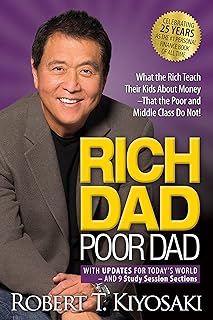
Book details
Title: Rich Dad Poor Dad
Author: Robert T. Kiyosaki (with Sharon Lechter)
Originally published: 1997
Category: Personal Finance, Entrepreneurship, Mindset
Synopsis
Rich Dad Poor Dad contrasts two money mindsets—one from Kiyosaki's highly educated "poor dad" (salary, job security, traditional path) and one from his entrepreneurial "rich dad" (assets, cash flow, and ownership). Through simple stories and rules of thumb, Kiyosaki argues that financial literacy, building/buying assets that generate income, and learning to think like an owner—not just an employee—are the foundations of wealth. The book introduces ideas like "the rich don't work for money," paying yourself first, understanding the difference between assets and liabilities, and using business and real estate as vehicles for freedom.
Reader perspective (Allen @ CDAERIS)
This was one of the first business books I read back in the late '90s, and it hit me like a switch. It challenged my comfortable, conservative approach and pushed me to shed the employee mindset, start my own business, and invest more boldly. Even where the book oversimplifies, it gave me a language for thinking in assets and cash flow—and the confidence to act. That shift has paid compounding dividends in how I build companies today.
Key ideas at a glance
- Think in assets, not paychecks: Own things that put money in your pocket (cash-flowing assets) rather than things that only take it out.
- Pay yourself first: Treat saving and investing as non-negotiable expenses.
- Learn the language of money: Accounting basics, taxes, and business structures are leverage, not trivia.
Who it's for
- Aspiring entrepreneurs and first-time founders
- Employees who feel capped by salary growth
- Anyone new to personal finance who wants a mindset reset
Before you dive in (useful caveats)
- It's a mindset book, not a how-to manual. You'll need other sources for step-by-step investing.
- Some stories are debated and concepts are simplified. Treat it as perspective-shifting, then go deeper elsewhere.
- Risk tolerance matters. "Bolder" doesn't mean reckless—run the numbers.
Great discussion prompts (team book club ready)
- What's an "asset" in your life today that actually behaves like a liability?
- If you had to create one new income-producing asset in the next 90 days, what would it be?
- Which belief about money did you inherit that you might retire now?
Recommended next reads
- The E-Myth Revisited (Gerber) – systems for small business
- The Millionaire Next Door (Stanley & Danko) – data behind wealth habits
- Cashflow Quadrant (Kiyosaki) – deeper dive on employee vs owner mindsets
- I Will Teach You to Be Rich (Sethi) – tactical personal finance playbook
Implementation mini-checklist (action in 30–60 minutes)
- List your top 10 monthly expenses → label each Asset or Liability (be honest).
- Identify one expense to convert into an asset within 90 days (e.g., turn a skill into a paid product/service).
- Block 2 hours this week to learn one financial skill (e.g., cash-flow statement basics, tax strategy for sole props).
Still Have Questions or Ready to Get Started?

From Inception to Expansion
At Cdaeris Consulting, we are more than just consultants; we are your partners in success. With our expertise, you’ll navigate the complexities of the business world with confidence and precision.
Contact us today to start your journey with Cdaeris Consulting!