
The Hidden Cost of Vertical Content Syndication in MSP Marketing
Why clone-posting damages LinkedIn reach, Google rankings, AI search visibility, email deliverability, and MSP brand reputationBy Chris Duncan, Fractional CRO for MSPs | Cdaeris Agency | Published May 2026 | Version
What Is Vertical Content Syndication?
Vertical content syndication in MSP marketing is the practice of a marketing agency writing one piece of content and distributing it identically across many client accounts in the same industry. Commonly called clone-posting, it covers LinkedIn posts, blog articles, email campaigns, and landing pages. MSPs typically do not know the same content is going to their direct competitors in the same market.
This paper documents the seven specific ways clone-posting damages the MSPs who unknowingly purchase it, each supported by 2026 platform and algorithm research.
Executive Summary: Seven Ways Clone-Posting Damages MSPs
In May 2026, a single LinkedIn post was published word for word to more than 700 different MSP feeds in a 24-hour window. The agency captured the value of the volume model. The MSP captured the costs.
1. LinkedIn Reach Collapses
The 2026 algorithm detects duplicate patterns and suppresses distribution before posts reach buyer feeds.
2. AI Tools Ignore Duplicates
95% of LinkedIn URLs cited in AI responses go to original content. Clone-posted content earns zero citations.
3. Google Rankings Stagnate
LinkedIn nofollow links pass no SEO authority. Google selects LinkedIn as canonical over the MSP blog.
4. Email Deliverability Collapses
Content fingerprinting permanently flags clone-posting senders. Shared infrastructure spreads damage across all clients.
5. Website Accumulates Algorithmic Debt
Google's scaled content abuse policy and the Helpful Content System site-wide classifier penalize entire domains for cloned pages.
6. Recovery Takes 6 to 18 Months
Damage accumulates faster than it pays down. Competitor MSPs gain ground during the entire recovery window.
7. MSP Reputation Degrades
Prospects, peers, and sales conversations suffer when buyers recognize the same content under multiple MSP names.
2. What Is Vertical Content Syndication
Vertical content syndication (clone-posting) is when a marketing agency creates a single piece of content and distributes that exact same content across many client accounts within the same industry. It covers LinkedIn posts, blog articles, email campaigns, and email newsletters.
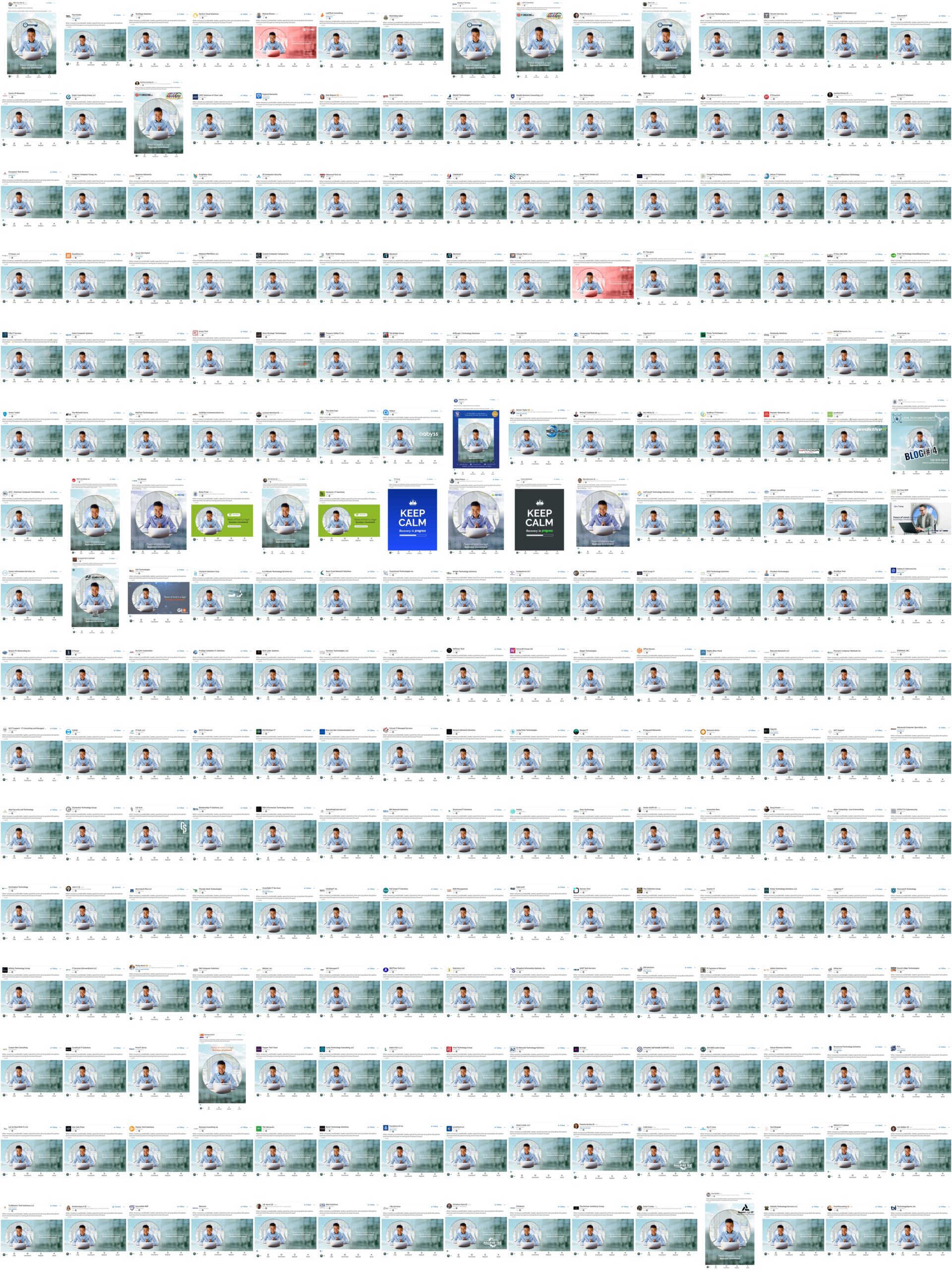
The same "Inbox Detox" graphic published identically across dozens of competing MSP LinkedIn feeds in a single posting window. Different company names, identical content.
What Clone-Posting Looks Like in MSP Marketing
Three MSP-focused marketing firms publicly describe operating models that include clone-posting or near-equivalents. Pronto Marketing markets templated subscription websites and syndicated blog content to over 1,300 active MSP clients. Tech Pro Marketing is described in industry reviews as offering a proven, one-size-fits-most system with nearly identical MSP sites in the same region. JoomConnect publicly defends the model, arguing that syndicated content does not inherently hurt SEO if the quality is good.
What Clone-Posting Does Not Include
Legitimate templated assets that operate at the layout and structural level (case study formats, service page frameworks, design systems) are not clone-posting. Clone-posting specifically refers to identical written copy distributed across many client accounts to the same audience pool in the same geographic and vertical market.
Why MSPs Do Not Notice
Most MSPs do not read their own social posts after the marketing firm publishes them, do not search LinkedIn for the headline they were sent, and do not check their own blog against other MSPs blogs in the same week. The agency does not volunteer that a large number of other MSPs are receiving the same content.
3. The LinkedIn Cost
LinkedIn's 2026 algorithm is built to detect duplicate content patterns and suppress distribution before posts reach a meaningful share of buyer feeds.
360Brew and Depth Score
LinkedIn's 360Brew framework reads each post against the author's stated expertise and the audience's engagement history. Posts matching a known duplicate pattern are flagged before they reach a meaningful share of the feed. The Depth Score subsystem evaluates dwell time, comment depth, save rate, and private share rate. Clone-posted content fails all four signals.
Topic DNA and the External Link Penalty
Topic DNA measures whether each post fits the established expertise pattern of the author's profile. Generic syndicated content cannot fit 700 different MSP profiles convincingly. Posts containing external links receive an estimated 60 percent reach reduction in 2026, which clone-posting agencies often include as a default CTA pattern.
Account-Level Pattern Detection
LinkedIn now applies account-level analysis that recognizes when many accounts post identical content within a short window. When 700 MSP accounts publish the same post on the same morning from the same scheduling tool, the platform reads this as a coordinated distribution pattern. The content is flagged and deprioritized.
The Compounding Effect
A company page that consistently posts low-engagement content accumulates a degraded baseline quality score over time, which depresses the reach of every future post, including original ones the MSP later writes. The penalty does not lift when the MSP stops clone-posting. It pays down slowly as new high-engagement content replaces the historical pattern.
4. The AI and GEO Cost
ChatGPT, Google AI Overviews, Perplexity, and Gemini now operate as the first stop in a growing share of buyer journeys. Clone-posted content is structurally invisible to these systems.
LinkedIn Is the Most-Cited Source for Professional Queries
Profound's March 2026 analysis found LinkedIn is now the most-cited domain in AI search for professional queries. Semrush's March 10, 2026 study counted 89,000 LinkedIn URLs cited by ChatGPT alone, appearing in 14.3 percent of all ChatGPT responses to professional questions. Eight Oh Two's 2026 consumer research found 67 percent of US adults now consult AI tools for purchase research.
95 Percent of Citations Are Original
Of the LinkedIn URLs cited in AI responses, 95 percent are original content with measurable engagement. Fifty-nine percent come from individual creator profiles, not company pages. The optimal format is LinkedIn long-form articles between 500 and 2,000 words and feed posts between 50 and 299 words. Clone-posted content collects effectively zero citations.
AI Overviews Intercept Google Clicks Too
On Google itself, AI Overviews now appear above standard search results for an increasing share of queries. When an AI Overview appears, Ahrefs' February 2026 research found organic click-through rates drop by 58 percent. The MSP's page can still rank and still receive zero clicks, because the AI summary above it answered the buyer's question.
What This Means in Plain Terms
When a buyer asks ChatGPT what to look for in a managed service provider for a 50-person law firm in Dallas, the AI builds its answer from cited sources. Clone-posted content is filtered out. The MSPs whose names appear in that AI-generated answer are the ones publishing original content from their actual perspective. Everyone else is functionally absent from the first stage of the buyer's journey.
5. The Google Cost
This chapter covers what happens in Google's search results. Chapter 7 covers what happens to the MSP's underlying website authority.
LinkedIn Links Pass No SEO Authority
Every external link on LinkedIn is automatically tagged rel="nofollow ugc", a directive that tells Google to pass no ranking authority through the link. This means a LinkedIn post linking to the MSP's website does nothing for the MSP's Google rankings, regardless of how many views or shares the post receives.
Canonical Selection Favors LinkedIn
When the same content also appears on the MSP's own blog (a common clone-posting pattern), Google's canonical selection algorithm chooses one version to rank and ignores the others. LinkedIn's domain authority is far higher than any MSP's blog, so Google almost always selects LinkedIn as the canonical version. The MSP's blog page becomes effectively invisible in search results.
AI Overviews Reduce CTR Even When Ranking Is Preserved
For queries where AI Overviews appear, organic click-through rates drop 58 percent on average, even when the underlying ranking position is preserved. Clone-posted content rarely earns AI Overview citation because the originality signal is too weak.
Social Signals Are Not Direct Ranking Factors
Google has confirmed that social media engagement metrics (likes, comments, shares) are not used as direct ranking signals. The viral LinkedIn post does not improve the MSP's search rankings. The MSP's marketing spend on social content builds no cumulative SEO asset.
6. The Email Marketing Cost
Many MSP marketing firms include a monthly newsletter or prospect cultivation drip campaign in their done-for-you MSP marketing packages, written once by the agency and sent across the entire client base. The damage splits into two distinct mechanisms.
Deliverability Damage
Gmail and Yahoo's bulk sender requirements took effect February 2024 and escalated in November 2025 from temporary delays to permanent rejections. Microsoft joined with similar requirements for Outlook, Hotmail, and Live.com in May 2025. Any domain sending 5,000 or more daily messages to consumer accounts is now permanently classified as a bulk sender. The classification does not expire even when volume drops.
The 0.3 percent spam complaint threshold is enforced as a hard ceiling. Once exceeded, the sender domain is ineligible for mitigation until it stays below 0.3 percent for seven consecutive days. Most agency newsletters distributed across hundreds of MSPs hit this threshold quickly because the content is generic and the lists are stale.
Content fingerprinting is the specific mechanism for clone-posted email. Gmail, Outlook, and Yahoo all use fuzzy hashing to detect identical and near-identical message content across many senders. When 700 MSPs send the same agency-written newsletter, every copy generates a matching fingerprint. One MSP's audience flagging the email as spam damages the reputation of that fingerprint, which affects deliverability for every other MSP using the same template.
Content Damage
Gmail's Gemini AI now runs a real-time inbox relevance test for each delivered message. If 60 percent of a sender's recipients immediately delete messages without opening them, the pattern signals to Gmail that the content is not valued. The MSP's newsletter starts landing in the Promotions tab, then in spam, then disappears entirely through silent suppression. The MSP cannot see this damage in their email analytics because the metrics that would reveal it are not measured.
The compounding scenario specific to vertical clone-posting: a buyer at a 75-person professional services firm receives the same agency-written cybersecurity newsletter from three to five different MSPs in their inbox over the same week. The buyer marks one as spam. The fingerprint reputation collapses. Deliverability tanks across every MSP using that template.
7. The Website Cost
When clone-posted content is also syndicated to the MSP's own blog, the damage moves from search rankings into the underlying authority of the entire website.
The Scaled Content Abuse Policy
Google introduced a scaled content abuse policy in March 2024 defined as generating many pages primarily to manipulate search rankings, with little or no value added for users. Enforcement intensified in the March 2026 core update. Penalties range from ranking demotion to feature exclusion to complete removal from search results. Recovery requires demonstrating a genuine change in content quality direction.
The Helpful Content System Site-Wide Classifier
Google's Helpful Content System became part of the core ranking algorithm in March 2024. It produces a site-wide signal: if a significant portion of a site contains unhelpful material, even the site's high-quality pages see ranking declines. Identical templates stamped across hundreds of pages is specifically named as a failure pattern. The classifier runs continuously. One section of templated blog content tanks rankings for the entire MSP website.
siteAuthority, pandaDemotion, and siteFocusScore
The 2024 Google API leak confirmed three site-level signals. siteAuthority is a domain-level authority metric. pandaDemotion is a site-wide demotion signal that operates as algorithmic debt: every low-quality, thin, or duplicate page contributes to the debt. Once a critical threshold is crossed, the entire site's visibility is suppressed. siteFocusScore measures topical coherence; clone-posted content drags this signal down because the content is generic by design and cannot build coherent topical authority for any one MSP.
Local SEO Damage
Most MSPs target a defined geographic market, which makes local SEO the highest-value organic channel. For MSPs using clone-posted content, the consequences are Map Pack exclusion, lower local pack rankings, and reduced visibility for the geographic and vertical queries that should produce the highest-intent buyers.
8. The Recovery Cost
Damage from clone-posting accumulates faster than it can be paid down. The recovery curve is asymmetric, and the asymmetry has business consequences.
Search Recovery: 6 to 18 Months
Multiple 2026 sources converge on a recovery timeline of 6 to 18 months for sites hit by Helpful Content System demotions, scaled content abuse penalties, or pandaDemotion accumulation. Recovery is not automatic. Google's documentation states it requires demonstrating a genuine change in content quality direction. The MSP must remove, rewrite, or substantially improve every clone-posted page on the site, then wait for Google's continuous classifier to re-evaluate the domain.
Email Recovery: 2 to 3 Weeks for Partial, Longer for Full
Engagement-based filtering damage in Gmail recovers in 10 to 20 days if the sender stops mailing the full list and segments down to only highly engaged recipients. Domain-level reputation damage from content fingerprinting takes longer because the fingerprint must age out of recent campaign databases and the sender must build a new pattern of engagement.
Competitors Gain Ground During the Recovery Window
During the recovery period, the MSP cannot compete effectively in organic search, AI citation, or email deliverability. Competitor MSPs that did not run clone-posting programs continue publishing original content, accumulating links and citations, and building author and domain authority. The MSP emerges from the recovery window into a more competitive landscape, with less authority and a longer climb ahead.
What Recovery Does Not Undo
Recovery clears the algorithmic penalties. It does not restore the buyer relationships damaged when prospects saw the MSP's content under five competitor names. The financial cost of the recovery window often exceeds the cost of the clone-posting contract that produced the damage.
9. The Reputation Cost
Beyond the algorithmic damage, clone-posting damages MSP reputation in three audiences that matter to the business.
Industry Peers and Competitors Notice
MSP-focused marketing analysts publicly document the clone-posting model and name the firms practicing it. MSPs that clone-post become identifiable to industry peers and lose standing in vendor partnership conversations, referral networks, and industry community discussions.
Sales Conversation Friction
Buyers who scroll LinkedIn at the executive level see the same post three to five times in a quarter under different MSP names. By the time a sales conversation begins, the buyer carries an implicit recognition pattern. Sales reps report buyers referencing seeing the content elsewhere, asking whether the MSP wrote it, and quietly downgrading their interest. The proposal-to-signature time lengthens. Close rates drop.
Prospect Trust Collapses on Detection
A subset of prospects will catch the duplicate content directly. They Google a phrase from the MSP's post and find five MSP sites running the same article. When this happens, the credibility damage is binary. The prospect concludes the MSP is not the source of its own thought leadership. The conversation ends.
10. What Original Content Actually Looks Like
The alternative to clone-posting is original content rooted in the MSP's actual operating experience. Whether delivered through a done-for-you MSP marketing retainer or a fractional CMO engagement, original content has a recognizable shape.
Single Voice, Consistent Over Time
LinkedIn's reframing of social media performance in 2025 was "Be seen, be mentioned, be considered, be chosen." The MSPs that show up in AI search results, rank in organic search, and earn buyer trust are the ones whose content reads as a single voice over time, talking about the specific problems their market actually has.
Geo-Lock and Local Trigger Response
Original MSP content reflects the operator's local market: a ransomware incident at a hospital in the MSP's metro area, a state-level data privacy bill, a regional cyber insurance change. These trigger events generate the highest-performing content. Generic content cannot respond to local triggers because it is not written within hours of local events. A serious marketing partner does not sell the same content to two MSPs in the same market. Cdaeris calls this geo-lock: only one MSP per metropolitan area receives any given piece of content.
Operating Model
Original content takes a specific operating model: a named writer who talks with the MSP every week or two, a defined posting cadence the algorithm research supports (two to three posts per week), and a signal intake process that captures the operator's thinking from podcast appearances, internal messages, and customer conversations. There is no version of this work that sustainably costs $500 per month for a full social media program.
11. What to Ask Before You Sign
Six questions to ask any marketing firm selling MSP marketing services or done-for-you MSP marketing. The answers reveal whether clone-posting is in the proposal.
- How many MSP clients do you serve, and how do you ensure I am not receiving the same content as another MSP in my market? A serious partner names a number under 100 and describes geographic territory exclusivity in their contract.
- Can I see five LinkedIn posts you published for a current MSP client this month? Then search the headlines on LinkedIn. If the same posts appear under other MSP names, the firm is clone-posting.
- Who writes the content? A named writer who will talk with the MSP weekly is the right answer. A content team or content engine without named individuals is a red flag.
- What does the content development workflow look like for a single post? The answer should describe input from the MSP, drafting by a named writer, MSP review, and publication.
- Will any of this content be published verbatim under another MSP's brand name? The answer should be a flat no, in writing.
- What is your approach to making my content cite-worthy for AI search? The firm should reference originality, first-hand experience signals, named authors, and engagement metrics.
Red Flags During the Sales Conversation
- Pricing below $1,000/month for full social media management
- Portfolio examples shown without naming the client MSPs
- Promises of daily posts
- Inability to show analytics on individual post performance for the specific MSP being prospected
- Phrases like proven content library, ready-run campaigns, or battle-tested templates in the proposal
12. Closing Observations
Clone-posting solves a marketing agency's problem. It does not solve an MSP's problem. The economic logic of the agency model rewards volume over differentiation, and the MSP pays for that logic in reach, search visibility, AI citation, deliverability, site authority, recovery time, and reputation.
The MSPs that show up in 2026 buyer journeys are the ones whose pages look like a single voice talking, week after week, about the specific things their market actually cares about. That voice cannot be templated. It cannot be syndicated. It comes from the MSP itself, with a writer who knows the MSP well enough to translate the operator's thinking into a feed people actually want to read, AI systems actually want to cite, and prospects actually want to hire.
Frequently Asked Questions
What is vertical content syndication (clone-posting) in MSP marketing?
Vertical content syndication is the practice of a marketing agency writing one piece of content and distributing it identically across many MSP client accounts in the same industry. Also called clone-posting, it covers LinkedIn posts, blog articles, email campaigns, and landing pages. MSPs typically do not know the same content is being sent to their direct competitors in the same market.
How does clone-posting affect MSP LinkedIn reach?
LinkedIn's 2026 algorithm uses the 360Brew framework and a Depth Score system that detects duplicate content patterns and suppresses distribution. When hundreds of MSPs post identical content from the same scheduling tool, LinkedIn flags the pattern as coordinated distribution and reduces reach before posts reach buyer feeds. The account-level penalty also degrades every future post, including original content published afterward.
Does clone-posted blog content hurt MSP Google rankings?
Yes. Google's scaled content abuse policy, intensified in the March 2026 core update, targets sites that generate many near-identical pages. Google's Helpful Content System applies a site-wide classifier: if a significant portion of a site contains duplicate or unhelpful content, rankings decline across the entire domain, including original pages. The pandaDemotion signal confirmed in the 2024 Google API leak compounds this across all pages on the domain.
How does clone-posting damage email deliverability?
Gmail, Yahoo, and Microsoft use content fingerprinting (fuzzy hashing) to detect identical or near-identical messages across many senders. When hundreds of MSPs send the same agency-written newsletter, every copy shares the same fingerprint. If one MSP's audience marks the email as spam, it degrades deliverability for every other MSP using the same template. Agencies on shared IP pools compound this risk further across all clients on that infrastructure.
How long does it take to recover from clone-posting damage?
Search ranking recovery typically takes 6 to 18 months and requires removing or substantially rewriting every clone-posted page, then waiting for Google's continuous classifiers to reassess the domain. Email deliverability partially recovers in 10 to 20 days if sending is restricted to highly engaged recipients only. Competitive ground lost during the recovery window is not automatically restored when rankings return.
What should I ask an MSP marketing firm to avoid clone-posting?
Ask how many MSP clients they serve and how they protect geographic territory exclusivity. Request five recent LinkedIn posts from a current client, then search the headlines to check for duplicates under other MSP names. Ask who writes the content by name, how the development workflow operates, and confirm in writing that content will never be published verbatim under another MSP's brand. If the answer to that last question is anything other than a flat no, the firm clone-posts.
See How Cdaeris Approaches MSP Marketing
Original content, named writers, geographic territory exclusivity, and a signal intake process that captures your perspective. Read the full service overview at cdaeris.com.
About the Author
Chris Duncan provides Fractional CMO services to managed service providers through Cdaeris Agency, advising MSP leadership on marketing strategy, vendor evaluation, and the operational mechanics of content marketing that actually performs. All claims in this paper are supported by citations in the References section.
References | All sources accessed January to May 2026.
- van der Blom, R. Algorithm Insights Report 2025. richardvanderblom.com
- Sprout Social. LinkedIn Algorithm: Complete 2026 Guide. sproutsocial.com
- Profound. Q1 2026 AI Search Citation Analysis. tryprofound.com
- Semrush. LinkedIn URLs in ChatGPT Responses: March 2026 Study. semrush.com
- Eight Oh Two. 2026 Consumer AI Search Behavior Report. eightohtwo.com
- Ahrefs. AI Overviews CTR Impact Analysis, February 2026. ahrefs.com
- BrightEdge. AI Overviews Prevalence Tracking. brightedge.com
- Google Search Central. Duplicate Content and Canonical URLs. developers.google.com
- Content Marketing Institute. Content Syndication: SEO Implications. contentmarketinginstitute.com
- Google Search Central Blog. Scaled Content Abuse Policy, March 2024. developers.google.com
- Google Search Central. Helpful Content System Documentation. developers.google.com
- Google. March 2024 Core Update and New Spam Policies. developers.google.com
- Hobo Web. Mapping of Google Updates to Leaked Internal Ranking Signals. hobo-web.co.uk
- Invrse Marketing. What is E-E-A-T and Why It's Important for SEO in 2026. invrsemarketing.com
- BizIQ. How Local SEO Drives Traffic to Every Franchise Location, 2026. biziq.com
- Google Workspace Admin Help. Email Sender Guidelines FAQ. support.google.com
- Yahoo Postmaster. More Secure, Less Spam. blog.postmaster.yahooinc.com
- Mailgun. New Bulk Sender Requirements 2024-2025. mailgun.com
- InboxEagle. Email Deliverability for Agencies. inboxeagle.com
- Mailpool. Multi-Tenant Email Architecture. mailpool.ai
- Mailbird. Gmail Anti-Spam Updates 2026. getmailbird.com
- Folderly. How Gmail's Gemini AI Changes Email Deliverability in 2026. folderly.com
- Mailsoar. Email Content Fingerprinting: Impact and Optimization. mailsoar.com
- Review My Emails. What is Content Fingerprinting. reviewmyemails.com
- Tech Pro Marketing on SmarterMSP. The MSP Guide to Creating an Effective Email Newsletter. smartermsp.com
- Tortoise and Hare Software. MSP Marketing Reviews. tortoiseandharesoftware.com
- Lemonade Stand. MSP Marketing Competitive Analysis. golemonadestand.com
- MSP Camp. Create High-Value Content to Drive MSP Marketing Success. msp-camp.com
- Pronto Marketing. Services and Client Information. prontomarketing.com
- Buffer. State of Social Media 2026. buffer.com