
Last Updated: June 2026
The 2x2 Positioning Grid: A 30-Minute Exercise to Find Your Competitive Corner
A 2x2 positioning grid (also called a perceptual map) is a two-axis diagram that maps where your brand and your competitors sit in the minds of buyers. Each axis represents a quality customers actually care about. The grid reveals who owns which corner of the market, and which corners are unclaimed.
Answer capsule: To use the 2x2 positioning grid, choose two attributes your best customers value, draw four quadrants, plot each competitor honestly, then identify the empty corner. That empty space is your defensible position. The exercise takes 30 minutes and works best as a team activity with your sales or leadership group.
This exercise comes from Seth Godin's This Is Strategy (2024), discussed in the Leadership Lounge Book Club. It is one of the most immediately usable tools in the book for sales teams and business owners competing in crowded markets.
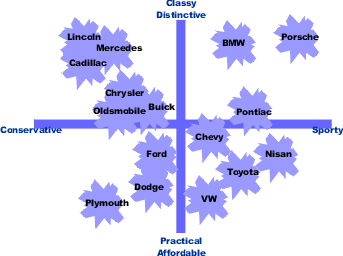
Example perceptual map of automobile brands across two axes. Source: Wikimedia Commons (CC BY-SA)
Why Most Businesses Compete From the Wrong Position
Most businesses are losing sales they should be winning, and the reason is not price, not effort, and not the economy. The reason is that they look just like everyone else. When a buyer cannot tell you apart from three other options, the decision defaults to price.
Price competition is a race no one wins sustainably. Customer retention is where the profit hides. Harvard Business Review reports that increasing customer retention by just 5% can raise profits by 25% to 95%, citing research by Frederick Reichheld of Bain & Company. When buyers cannot tell you apart, they churn to whatever is cheaper next quarter, and that compounding loss costs far more than the discount that won the deal.
Seth Godin names the trap precisely in This Is Strategy: "Moving your competition to the center, the catch basin of mediocrity, is a powerful strategy." That only works when you are the one doing the moving. Most businesses drift into the center on their own, pulled by the feedback loop of trying to serve everyone.
The 2x2 positioning grid gives you a visual tool to see exactly where you are, where your competitors are, and where the open space lives.
What Is the 2x2 Positioning Grid?
The 2x2 positioning grid is the practitioner name for what marketing researchers call a perceptual map, a tool in use since the 1960s to visualize competitive positioning based on buyer perception. It uses two axes, each representing a quality buyers actually care about, to plot brands in the four resulting quadrants.
Godin illustrates it with an automotive example: Hummer, Porsche, Hyundai, and Ford F-150 each occupy a distinct quadrant on a grid built around power versus agility and luxury versus value. None of those brands truly competes with the others. A Porsche buyer and a Hyundai buyer are not making the same decision.
The key rule, as Godin states it directly: "Each end of the axis has to be something that a customer might want, not what you want, what they want." This eliminates the most common mistake in competitive mapping, which is building axes around your own preferences rather than buyer criteria.
The same dynamic exists in every industry. The grid makes it visible and actionable in a single whiteboard session.
How to Run the 2x2 Positioning Grid Exercise
Time required: 30 minutes. Format: Whiteboard or paper. Who should be in the room: Sales team, leadership, or both.
Step 1: Choose Your Axes
Pick two things your best customers actually care about. These must be qualities a buyer would choose, not qualities you wish they valued. Common examples: speed versus thoroughness, personal versus enterprise, hands-on versus hands-off, affordable versus premium. Every end of every axis must represent something a real buyer might want. "Overpriced" is not an axis endpoint. No buyer ever chooses overpriced, so it cannot anchor an axis.
Step 2: Draw the Grid
Put your two axes on a whiteboard or piece of paper. Label all four ends clearly. You now have four quadrants, each representing a distinct market position. Name the quadrants if it helps your team understand the territory.
Step 3: Place Your Competitors Honestly
Place each competitor in the quadrant that best represents how their customers actually see them, not how you see them. Be honest. The value of this exercise depends entirely on accuracy. Inflating your position or deflating competitors produces a map that flatters you and misleads your team.
Step 4: Place Yourself
Where do you actually sit on this grid right now, based on what your customers say? If you are not sure, ask three recent customers to describe you in two or three words before the session. Their language will tell you more than your marketing copy ever will.
Step 5: Identify the Open Quadrant
Most grids have one corner that nobody has claimed, or one that a competitor nominally occupies but has not committed to defending. That open space is your opportunity. As Godin writes in This Is Strategy: "Build something that builds a square and it becomes yours to defend."
What to Do With What You Find
If you are sitting in the center of the grid alongside your competitors, that is the source of your pricing problem. Buyers in the center compare on price because no other distinction is clear. A better pitch will not fix it. The fix is a deliberate move toward a defensible corner.
If you find an open quadrant that aligns with what your best customers already value, that is your position to claim. Your messaging, your sales conversations, your client selection, and your delivery model all need to reinforce that corner consistently.
If you find that you are in a strong corner but your team describes the company differently in every sales conversation, that is an execution problem. You have a position but you are not using it. For more frameworks from This Is Strategy, visit the Leadership Lounge Book Club where the full book is discussed each Thursday.
A Note on Holding the Position
Positions drift when teams try to serve more types of customers or when leadership chases short-term revenue outside the defined corner.
Tiffany's held its position as exclusive, expensive, and aspirational for more than 50 years. When Avon acquired the brand in 1979 for approximately $100 million and moved it toward mass market pricing and broader distribution, the position collapsed within five years. Avon sold the brand for roughly the same amount they paid, having generated minimal return.
Shake Shack demonstrates the opposite. Starting as a single hot dog cart in Madison Square Park in 2001, the brand grew to more than 400 locations globally while maintaining its distinct position relative to traditional fast food. The position held because leadership made consistent choices that reinforced the same corner.
The Asana guide to perceptual mapping identifies "position drift," the gradual slide toward the center as businesses try to capture adjacent market segments, as the most common failure mode in competitive positioning. Owning a corner only works if you stay there.
The Team Exercise for Next Week
Bring your sales team together for 30 minutes. Draw the grid. Work through the five steps as a group. Then ask two questions:
1. Which corner do we own?
2. Are we showing up that way in every single sales conversation?
If people disagree on where you sit, or if different team members describe the company differently to prospects, you have found the root cause of a lot of lost deals. Alignment on position is a revenue problem. Treat it like one.
Frequently Asked Questions
What is a 2x2 positioning grid?
A 2x2 positioning grid is a two-axis diagram used in marketing and sales strategy to visualize where a brand and its competitors sit in the minds of buyers. Each axis represents a quality buyers care about. The four resulting quadrants each represent a distinct market position. The tool is also called a perceptual map or brand positioning map and has been used in market research since the 1960s.
How do you choose the axes for a positioning grid?
Each axis must represent a quality that buyers actually choose between, not qualities the business wishes buyers cared about. Both ends of each axis must be desirable to at least one buyer segment. Common axis pairs include affordable versus premium, hands-on versus self-directed, specialized versus generalist, and fast versus thorough. Avoid any endpoint that is purely negative such as low quality or overpriced, as those are competitive insults rather than positioning dimensions.
How long does the 2x2 positioning grid exercise take?
The exercise takes approximately 30 minutes when run as a team session. Gathering preliminary customer language by asking three to five customers how they describe the business adds one to two days of preparation but significantly improves the accuracy of the grid. The preparation step is optional but recommended for teams running the exercise for the first time.
What is the difference between a positioning grid and a perceptual map?
They describe the same tool. Perceptual map is the formal academic and market research term, in use since the 1960s in brand strategy and consumer research. Positioning grid is the practitioner term used by Seth Godin and most sales and marketing consultants. Both refer to a two-axis diagram plotting brands by buyer perception to identify competitive territory.
What if our business is in the center of the grid?
A position in the center means buyers cannot clearly distinguish you from competitors, which drives price-based comparison and lower retention. The fix is to identify which corner best reflects your best customers actual values, then move deliberately toward that corner through consistent messaging, client selection, and delivery choices. The center is not a stable long-term position in a competitive market.
How often should we revisit the positioning grid?
Run the exercise as a new hire orientation tool, before major proposals or rebranding decisions, and as a quarterly sales team check-in. Positions drift when teams try to serve too many buyer types at once. Quarterly reviews catch drift before it becomes a pricing or retention problem.
This exercise is drawn from chapters 242 of This Is Strategy by Seth Godin, discussed in the Leadership Lounge Book Club. Join us every Thursday at noon Pacific.

About the Author
Chris Duncan
Sales Scientist & Trainer, Cdaeris Agency
Chris Duncan helps B2B founders and CEOs turn chaotic, last-minute selling into predictable revenue. Through Cdaeris Agency he builds disciplined sales strategy, pipeline systems, and team performance coaching for growth-focused companies in the $1.5M to $10M range. He hosts the Leadership Lounge Book Club, where working operators pull usable tactics out of strategy books like This Is Strategy.